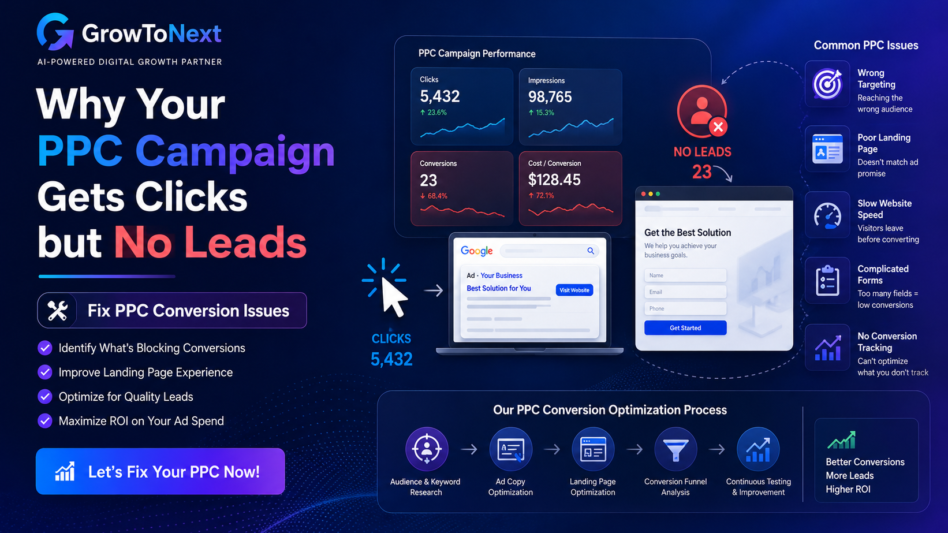
Seeing clicks roll into your PPC campaigns can feel encouraging at first. Your ads are getting impressions, users are clicking, and traffic is reaching your website. But if those clicks are not turning into inquiries, phone calls, or form submissions, something is clearly missing.
The reality is simple: clicks do not generate revenue—leads do.
Many businesses spend significant amounts on Google Ads and other PPC Platforms only to discover that traffic alone does not guarantee results. If your campaigns are generating clicks but failing to produce qualified leads, the issue usually lies in your targeting, messaging, landing pages, or conversion tracking.
Understanding Clicks vs. Leads
A click simply means someone found your ad interesting enough to visit your website.
A lead is much more valuable. It represents a user who takes action by filling out a form, requesting a quote, booking a consultation, or calling your business.
Many PPC campaigns focus heavily on driving traffic rather than attracting people who are actually ready to buy. As a result, businesses end up paying for visitors who browse and leave without taking action.
Successful PPC campaigns are designed to generate conversions, not just clicks.
Common Reasons Your PPC Campaign Gets Clicks but No Leads
Targeting the Wrong Audience
One of the biggest PPC mistakes is targeting too broadly. While broad targeting may increase traffic, it often attracts users who have little interest in your products or services.
If your ads are reaching the wrong audience, visitors may click out of curiosity but quickly leave without converting.
Refining audience targeting based on location, demographics, interests, and buying behavior helps attract more qualified prospects.
Using Low-Intent Keywords
Not all keywords indicate purchase intent.
For example, someone searching for “What is PPC advertising?” is likely researching. Someone searching for “PPC agency near me” is much closer to making a buying decision.
High-volume informational keywords often generate traffic but not leads. Focusing on high-intent keywords can dramatically improve campaign performance.
Ad and Landing Page Mismatch
Your ad creates an expectation. When visitors click, they expect to see exactly what was promised.
If your landing page delivers a different message, offer, or experience, users become confused and leave.
Consistency between ad copy and landing page content improves trust, engagement, and conversion rates.
Weak Value Proposition
Even if visitors arrive on your landing page, they need a compelling reason to take action.
A weak offer that fails to clearly communicate benefits will struggle to convert. Your messaging should explain:
- What problem you solve
- Why you’re different
- What users gain
- Why they should act now
Strong offers remove uncertainty and encourage action.
Poor Landing Page Experience
Landing pages often determine whether a campaign succeeds or fails.
Common conversion killers include:
- Slow page speed
- Complicated forms
- Poor mobile experience
- Weak headlines
- Too many distractions
- Lack of trust signals
The best landing pages focus on one goal and guide users toward a single clear action.
Incorrect Conversion Tracking
Many businesses make decisions based on inaccurate data.
If conversion tracking is broken, campaigns may appear successful while generating little actual business value. Some accounts count minor interactions as conversions, while others fail to track real leads altogether.
Without accurate tracking, advertising platforms cannot optimize effectively.
How to Fix a PPC Campaign That Isn’t Generating Leads
Refine Audience Targeting
Review who is currently clicking your ads and compare that audience with your ideal customer profile.
Use location targeting, audience exclusions, demographic filters, and in-market audiences to focus your budget on people most likely to convert.
Focus on High-Intent Keywords
Regularly review search term reports and eliminate irrelevant queries.
Prioritize keywords that indicate buying intent, including terms such as:
- Hire
- Get a quote
- Near me
- Best company
- Services
- Consultant
These searches typically generate more qualified leads.
Improve Landing Pages
Your landing page should immediately communicate value.
Make sure:
- The headline is clear
- Benefits are visible
- Forms are simple
- Mobile experience is optimized
- Page speed is fast
- Calls-to-action are prominent
Small improvements can significantly increase conversion rates.
Align Ads and Landing Pages
Every ad should connect directly to a relevant landing page.
The messaging, offer, and call-to-action should feel like a natural continuation of the ad that generated the click. Consistency builds trust and reduces bounce rates.
Run Ongoing A/B Tests
Optimization is an ongoing process.
Test one element at a time, including:
- Headlines
- CTA buttons
- Images
- Form length
- Offers
- Layouts
Continuous testing helps identify what drives the highest conversion rates.
Verify Conversion Tracking
Regularly test forms, phone call tracking, and conversion tags to ensure accurate reporting.
Tools such as Google Tag Assistant and Google Ads Diagnostics can help identify tracking issues before they impact performance.
Implement Retargeting Campaigns
Most visitors do not convert on their first visit.
Retargeting allows you to reconnect with users who previously visited your website but did not take action. These campaigns often generate higher conversion rates because the audience is already familiar with your brand.
Conclusion
Clicks alone do not determine PPC success. The true measure of performance is how many qualified leads your campaigns generate.
If your ads are attracting traffic but not producing inquiries, the issue usually stems from audience targeting, keyword selection, landing page quality, offer strength, or inaccurate tracking.
By improving these areas, businesses can transform underperforming PPC Campaigns into reliable lead-generation channels that deliver measurable ROI and long-term growth.
Frequently Asked Questions (FAQs)
Q1. Why am I getting clicks but no leads from Google Ads?
This typically happens because of poor targeting, low-intent keywords, weak landing pages, inconsistent messaging, or incorrect conversion tracking.
Q2. What is the difference between a click and a lead?
A click occurs when someone visits your website from an ad. A lead occurs when that visitor takes a valuable action such as submitting a form, calling, or requesting a quote.
Q3. How can I improve PPC conversion rates?
Improve audience targeting, focus on high-intent keywords, optimize landing pages, strengthen your offer, and ensure accurate conversion tracking.
Q4. Why is my landing page not converting visitors?
Common issues include slow loading speed, poor mobile usability, weak headlines, complicated forms, lack of trust signals, and unclear calls-to-action.
Q5. How important is conversion tracking in PPC?
Conversion tracking is critical because it helps measure campaign success and allows advertising platforms to optimize for actual business results.
Q6. Should I use retargeting in PPC campaigns?
Yes. Retargeting helps reconnect with users who previously visited your website and often generates higher conversion rates than first-time traffic.
Q7. How long does it take to improve PPC lead generation?
Some improvements can show results within days, while larger optimizations involving targeting, testing, and landing page changes may take several weeks to deliver consistent performance gains.


 post by