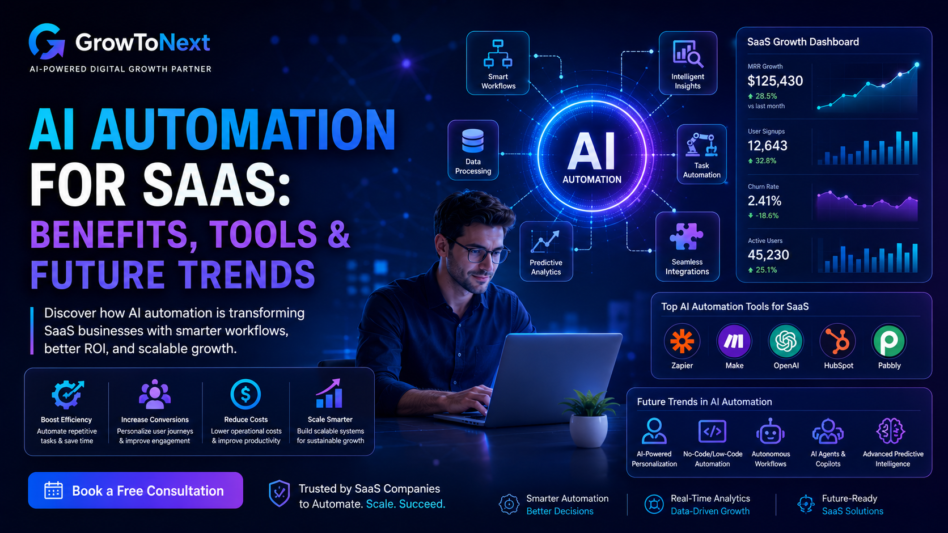
AI automation is transforming the SaaS industry. What once involved simple automated emails and ticket routing has evolved into intelligent systems capable of predicting user behavior, personalizing experiences, automating workflows, and making data-driven decisions.
As customer expectations continue to rise, SaaS companies are increasingly adopting AI to improve efficiency, reduce costs, and scale operations. Businesses that successfully integrate AI-Powered Business Automation gain a significant competitive advantage through faster processes, better customer experiences, and smarter decision-making.
What is AI Automation for SaaS?
AI automation in SaaS refers to the use of artificial intelligence to automate tasks, workflows, and decisions within cloud-based software platforms.
Unlike traditional automation, which follows predefined rules, AI-powered systems learn from data and adapt over time. For example, instead of sending the same onboarding email to every new user, AI can analyze user behavior, industry, and interests to deliver personalized onboarding experiences.
The result is greater efficiency, improved customer engagement, and enhanced business performance.
Why SaaS Companies Are Investing in AI Automation
Rising Customer Expectations
Modern users expect instant support, personalized experiences, and seamless onboarding. AI enables SaaS businesses to deliver these experiences at scale through intelligent chatbots, proactive messaging, and behavior-based recommendations.
Reduced Operational Costs
Many business processes such as ticket management, invoice generation, reporting, and data entry are repetitive and time-consuming. AI automates these tasks, reducing human effort and operational expenses while improving accuracy.
Better Workflow Management
As SaaS companies grow, managing complex workflows becomes challenging. AI helps coordinate tasks across departments, streamline processes, and ensure information reaches the right people at the right time.
Faster Support and Personalization
AI-powered support systems provide instant responses, route tickets intelligently, and personalize interactions based on customer behavior, improving satisfaction and response times.
Enhanced Security
AI continuously monitors user activity, login behavior, and system access to identify unusual patterns and potential threats. This proactive approach strengthens cybersecurity and reduces risks.
Competitive Advantage
In a crowded SaaS market, superior execution matters. Companies using AI can offer faster onboarding, smarter support, and more personalized experiences, helping them stand out from competitors.
Key Benefits of AI Automation for SaaS
Smarter Customer Support
AI chatbots and automated ticket routing reduce response times and improve service quality. Sentiment analysis can also identify frustrated customers before issues escalate.
Improved Customer Retention
AI analyzes usage patterns, engagement metrics, and customer behavior to identify accounts at risk of churning. Businesses can then take proactive steps to improve retention.
Increased Revenue Growth
Automation improves sales efficiency, reduces operational costs, and helps marketing teams target high-intent prospects more effectively, driving overall business growth.
Better Product Development
AI helps product teams analyze user behavior, categorize feedback, and identify features that contribute most to customer retention, enabling smarter development decisions.
Marketing and Sales Automation
AI-powered lead scoring, personalized email campaigns, CRM updates, and follow-up scheduling allow sales and marketing teams to focus on strategic activities rather than administrative work.
Top AI Automation Use Cases for SaaS
AI-Powered Customer Onboarding
AI customizes onboarding experiences based on user roles and behavior, helping customers reach value faster and reducing early-stage churn.
Predictive Analytics
AI dashboards provide forecasts, identify trends, and highlight risks such as customer churn, enabling teams to make proactive decisions.
AI Sales Assistants
AI automates CRM updates, lead qualification, follow-up recommendations, and sales coaching, allowing sales teams to spend more time selling.
Automated Billing Systems
AI manages subscription billing, payment processing, fraud detection, and payment recovery workflows, improving financial operations.
AI-Driven CRM Workflows
Customer records are automatically updated, enriched, and monitored, ensuring sales and customer success teams always have accurate information.
Intelligent Knowledge Bases
AI-powered knowledge bases analyze support tickets and user queries to surface the most relevant answers, reducing support workload and improving self-service.
Workflow Automation
AI connects multiple systems and automates end-to-end business processes, from customer onboarding and invoicing to account management and reporting.
Popular AI Automation Tools for SaaS
Several tools help SaaS companies implement AI automation effectively:
- Zapier – No-code workflow automation.
- Workato – Enterprise-level automation platform.
- Intercom AI – Customer support and engagement automation.
- Zendesk AI – Intelligent ticket management and support.
- Mixpanel – Product analytics and user behavior tracking.
- Amplitude – Advanced customer journey analytics.
- HubSpot AI – Marketing, sales, and CRM automation.
Agentic AI: The Future of SaaS Automation
Agentic AI represents the next generation of automation. Unlike traditional chatbots that respond to individual requests, AI agents can independently execute complex, multi-step tasks.
For example, an AI agent can identify a customer at risk of churning, analyze usage data, create a personalized retention campaign, update CRM records, and escalate concerns to a customer success manager if necessary.
This level of automation significantly reduces manual intervention while improving business outcomes.
Best Practices for Implementing AI Automation
Start Small
Begin with repetitive, high-volume tasks such as ticket routing, reporting, or invoice generation. Early wins build confidence and create momentum.
Define Clear KPIs
Measure success using metrics such as response times, conversion rates, onboarding completion rates, and churn reduction.
Follow an MVP Approach
Launch simple automation projects first, gather feedback, and gradually expand functionality.
Prioritize Data Quality
AI systems are only as effective as the data they use. Clean, organized, and consistent data is essential for accurate automation.
Build API-First Workflows
Strong API integrations ensure AI can communicate effectively across systems and scale with future business needs.
Focus on Security and Governance
Implement access controls, audit logs, compliance monitoring, and human oversight for critical decisions to maintain trust and security.
Conclusion
AI-Enhanced SaaS Solutions is rapidly becoming a core part of successful SaaS operations. From customer support and onboarding to sales, analytics, and security, AI helps businesses improve efficiency, reduce costs, and deliver better customer experiences.
The companies gaining the greatest advantage are not necessarily those with the most advanced technology, but those that implement AI strategically, measure results, and continuously optimize their processes. As AI continues to evolve, SaaS businesses that embrace automation today will be better positioned for long-term growth and success.


 post by